Goldmund and Lise’s Relationship
Narcissus and GoldmundGoldmund and Lise’s Relationship is a brief, formative encounter that changes Goldmund’s sense of himself and sends him out from the cloister into the open world. It begins with Lise finding him asleep in the fields, develops through an unspoken intimacy and a promised meeting, and ends when she returns to her husband. Its decisive consequence is not a lasting union but Goldmund’s awakening: he understands the encounter as a message from his mother, recognizes that he cannot remain a student, and sets off alone.
Meeting and First Intimacy
Goldmund meets Lise after falling asleep outdoors in the heat. She comes from the forest carrying a bundle, notices the young man among the fallow fields, and approaches when she sees that he is asleep and does not appear dangerous. His head rests in her lap when he wakes. They exchange a kiss without speaking, and the scene recalls for him an earlier encounter with a girl in the village. Lise’s presence makes the meeting immediate and intimate, while the silence gives Goldmund no explanation of who she is or where she belongs.
Only afterward does Goldmund learn her name. When he asks who she is, she says, “I’m Lise,” and he repeats the name as though discovering its sweetness. Their conversation reveals the disparity between them: Goldmund is a student living in the cloister, while Lise says that she lives nowhere. She invites him to come to her that night, and tells him to leave the cloister and call out like a barn owl so she can find him. Goldmund agrees. Their meeting therefore joins an abrupt personal awakening to a concrete break with the regulated life he has known.
Awakening and Departure
Goldmund later explains the encounter to Narcissus as something more profound than being in love. When he woke with his head in Lise’s lap, he felt as though his mother had come to take him home, although he knew Lise did not resemble her: Lise had black hair and brown eyes, whereas his mother had been blond. He understood the resemblance as inward rather than physical, an experience of his mother’s call carried by an unknown woman.
In Goldmund’s account, the encounter releases feelings and longings that had been dormant. He describes his inner life as transformed and newly intelligible, and says that Lise taught him what a woman is. The experience also brings an immediate decision: he knows he can no longer stay in the cloister, not even for another day, and intends to leave when night falls. Narcissus listens and says that the sudden turn is broadly what he had expected. Their exchange makes the relationship a turning point in Goldmund’s life, but does not suggest that Lise has promised to accompany him or share his future.
Separation and Its Consequences
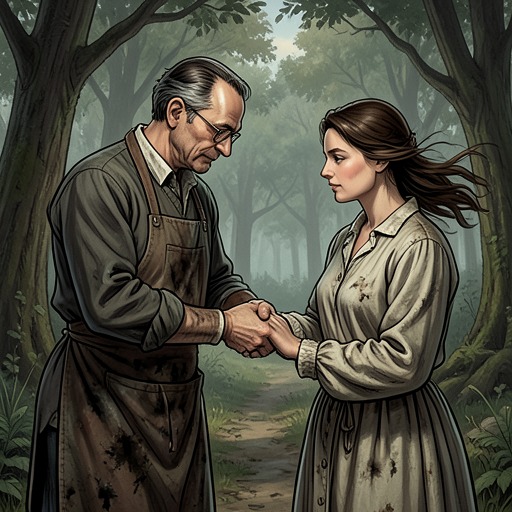
The morning after their night together, Goldmund assumes that they might remain together and offers to go with Lise. She tells him she must return to her husband, who will beat her for having stayed away. She says she will claim that she lost her way, though she expects him not to believe her. Her marriage and her expectation of punishment place a limit on Goldmund’s hope for a shared life.
Goldmund tells her that he will not beat her and asks whether she would rather stay with him than return to her husband. Lise refuses. Goldmund senses that she is drawing away and releases her hand; she cries and runs across the meadows, while he stands watching. He feels sorry for her and for himself, but does not pursue her. After sleeping again, he wakes to the day and walks on, carrying the memory of the encounter rather than a continuing relationship. The separation leaves him alone, but the world before him has changed: it is no longer a place glimpsed through a student’s window or a landscape from which he must return at the end of a stroll. It has become the setting of his own fate.
Meaning Within Goldmund’s Story
Lise’s importance to Goldmund lies in the way their brief relationship connects physical intimacy, maternal memory, and departure. He does not mistake her for his mother; instead, he interprets the encounter as a call associated with the mother he has lost. The relationship thus begins a movement away from the cloister’s ordered life and toward experience outside it. Goldmund’s own account to Narcissus frames this change as both sensual and existential: the encounter awakens him, gives shape to previously unrecognized longings, and makes his former life untenable.
The ending resists the idea that awakening guarantees mutual attachment. Goldmund offers kindness and imagines a life together, but Lise chooses—or feels bound—to return to her husband, despite the treatment she expects there. The novel leaves the relationship at that parting: Lise disappears from Goldmund’s immediate path, while he proceeds alone into the larger world. Its lasting place in his story is as a beginning, not a settled romance: an encounter that changes what he is ready to seek, even as it cannot provide him with a home.